Search This Blog

Friday, October 1, 2010

"Mind-Numbing Nonsense" contest!!!

    Ok! We're going to have a weekly contest! Do you ever watch the news and have your jaw drop into your huge bowl of ice cream at the insanity? You think you've heard the most insidious thing ever, and then the next day it's worse? I'm not talking about your run-of-the-mill murder and violence and stuff... no, no...much worse than that...the daily politics.
       We are going to review the "Mind-Numbing Nonsense of the Week" each Friday starting today. I marvel at what politicians and other rabble in DC think we're going to swallow and/or be ok with. So here's my favorite this week. You submit yours, and and next Friday we'll have everyone vote on the submissions. Each month, the winner will receive a $15.00 gift certificate to Amazon to purchase any right wing book I approve of!!
(just kidding - your choice). See? Here's a picture of the actual card! C'mon... you can trust me! Just give me your name and the address you want it sent to, then I'll sell your information, steal your identity and become a dastardly rich capitalist! (or.... you can give it to me by e-mail or PayPal account and you'll stay anonymous. Again, your choice.)
  I will post the winner each week and you can have your picture posted right next to your favorite zany politician! Wow! The fun never stops...

    I had so many to choose from this week. But my favorite has to be Cass Sunstein, the Regulatory Czar. He was questioned about a book he wrote and  this statement.           
      "Some conservative legal thinkers like Justice Scalia and Justice Thomas think that the Constitution means what it originally meant.  That means we should understand the document by going into a kind of ‘Time Machine’ and capturing the public understanding of the public that ratified the document a century or more than a century ago.”
        Wow... you mean... some of our supreme court justices actually believe in the original intent of the constitution? The one that they swore on a bible to uphold?? That is crazy! I'm sure when they were sworn in, they were thinking of another country's constitution or something.... duh! Ours is so worn out and out-dated.
     

Wednesday, September 29, 2010

Are you a follower??

 So last night I goofed around with the blog and clicked on this button "monotize". (remember how I am a computer genius?) Somehow I erased all your names in the "follow" section! Duh.... if you are following, please sign back in. It's fun to see your names. If you have questions or comments I would love to hear them. I feel like I'm "preaching to the choir". Isn't there someone out there who totally disagrees and thinks I'm a total crackpot? Please... no response from a son-in-law... Incidently, a little side note... this is what I received from one of four sons-in-law, Marshall, today.

         "I know what I'm getting you for Christmas this year":
 
         How to start a fight:
           One year I decided to buy my mother-in-law a cemetary plot as a Christmas gift. The next year, I didn't buy her a gift. When she asked me why, I replied, "Well, you still haven't used the gift I bought you last year!"
         That's how the fight started.

  Hmmmm... every family has one. I was fine with the cemetary plot thing... I just didn't want to be reminded of Christmas already! We love him anyway.
       

Monday, September 27, 2010

A Nation of Law - chapter 4

     Here are the discussion answer to the study guide questions. Great discussions in both classes on how our forefathers literally "invented" America and its government. You know what I found (and seem to find each week!) that there just hasn't been a whole lot of change in the vitriol and yuckiness that happens between men who put their own interests and greed before God's will. Isn't it interesting that with this history from over 200 years ago, you can plug in many of today's political names and it would be almost the same story. What is it they say about not reading our history??? We tend to repeat it??? Helllooooo! What these men must have gone through with no precedence on setting up a new government! Again...
evidence of God's hand in establishing this great nation.


A Nation of Laws Chapter 4
(APHOUS refers to A Patriot’s History of the United States)

Here are the study guide questions for this week. What these men must have gone through with no precedence on setting up a new government! Again... evidence of God's hand.

1.  The "American Experiment" began with setting up a new government. What obstacles did the Whigs face? There was no precedence. No nation on earth had ever had elected leaders, over half the entire population was under sixteen years of age. Rapid growth required some sort of central government.

2. What were the advantages the Whigs had in their favor?  They were already governing themselves, they had ingenuity, ideas, excitement, faith. They wanted to abolish slavery.

3. Though they had many differences, they were in total agreement on what kind of government for the infant nation? NO kings! abolish all stale unwritten laws that ruled elitist governments of the past.

4. What were some common beliefs about government that the Whigs identified with? That government should regulate as few aspects of our lives as are absolutely necessary.  People sustain a military and keep and bear firearms, "Due Process" (trial by jury), habeas corpus; opposition to cruel and unusual punishment, and other freedoms such as speech, petition, assembly, and religion, and freedom of the press. Localism, egalitarianism, libertarianism, expressed through written constitutions, and constrained by separation of power, legislative dominance, and direct representation. Sam Adams, "Jealousy is the best security of publick Liberty."

5. What was the chaos that took place shortly after the Revolutionary War? Disagreements over how this new government should be set up. Shays' Rebellion; a backlash to the Articles of Confederation which proved to have serious flaws. There was no president or any other independent executive, nor was there a federal judicial branch. Congress, the legislature, was the only branch of government. Members elected to congress did not vote as individuals, but as states. While congress did have some powers, it could not enforce its laws on the states or the people. States were permitted to coin their own money. There was no regulation of commerce between the states and states could even enter into treaties with foreign nations and declare war, with the consent of Congress. Congress could not tax the states or the people, it could only request funds to run the government.( That would be awesome!) The Articles created a confederation of independent states, not a nation. Under the Constitution, the balance of power shifted to the federal government.  Hamilton felt that the best solution was an aristocratic, strongly centralized, coercive, but representative union, with devices to give weight to the influence of class and property. Hamilton felt that there was too much democracy that "The people is a great beast!"

             *Why did the Articles of Confederation fail? Nationalists led by George Washington and Alexander Hamilton felt that the Articles lacked the necessary provisions for a sufficiently effective government. There was no president or executive agencies or judiciary. There was no tax base. There was no way to pay off state and national debts from the war years. In 1788, with the approval of Congress, the Articles were replaced by the United States Constitution and the new government began operations in 1789[2]. Under the articles, any decision had to be unanimous (they never were) and the states could decide on their own how much money to send to the Federal Government. Any army that the nation needed had to be drawn from the state militias, and each state determined what to send in the case of any hostilities.

6. How did the statement "separation of church and state" evolve? First appeared in a letter from Thomas Jefferson  http://en.wikipedia.org/wiki/Separation_of_church_and_state . Many religions complained that Jefferson's Virginia Sabbath law and ordinances sanctioning public days of prayer and fasting, etc. were unfair and "unfairly bound church and state." Everyone read and interpreted the bible for himself. They finally came to the conclusion that what mattered most was salvation and "right" living and not the actual structure of religion. The American Revolution had pushed American Christianity into evangelicism based on republicanism. Even de Tocqueville stated that in America, religion was "indispensable to the maintenance of the republican institutions" because it facilitated free institutions. Eventually, however, there was so much division in specific belief that America ceased to be a "godly" nation and became a "good" nation. Originally it meant “Freedom to worship, not freedom from worship.”This statement NEVER was part of the U.S. Constitution (APHOUS pg. 97-98.
              
7. So what Christian tenets did the religions basically agree on: The Ten Commandments, pray in schools and public functions, and that even if a public figure didn't ascribe to a particular faith, he was expected to act like a good Christian. (APHOUS pg. 98)
                  
8. With all the movement west, what new headaches did Congress face?  How to handle allotment of public lands, Indian policies, diplomacy with Spain and Britain. Lingering problem of public domainhttp://en.wikipedia.org/wiki/Public_domain: landed states with sea-to-sea land claims finally relinquished to the nation. Articles of Confederation were finally ratified which allowed gradual democratization of western territories.

9. What was the Northwest Ordinance? What critical components did it stipulate?
How did it affect slavery? Northwest Ordinance - (replaced Jefferson's "Ordinance of 1784.") It designated how the newly acquired land would be divided into states and how they would sell to individuals. Jefferson wanted to provide free or cheap land to people and keep it out of the hands of the government. By 1785 he had left congress and Congress wanted to increase price to gain revenue.  They divided several thousand townships into thirty-six 640 acre sections. Unfortunately, squatters (which was a legal way to get land) and speculators got there before the government could. This led to the Homestead Act 1862 which provided cheap and scientifically surveyed land with a valid title. Upon reaching population of 5,000 the landholding white male citizens could elect a legislature and a nonvoting congressional rep. Congress wrote a bill of rights and that no slavery or involuntary servitude would be permitted north of the Ohio River. Opponents raised the question of validity - is slavery a state or fed issue?
Dred Scott . A black man who had been freed and living in non-slave state, moved back to slave state and appealed to government for his freedom. The judge said that blacks would "never be allowed full citizenship in America" and would not allow his freedom. Frederick Douglass, however, exclaimed that he was happy that slavery was now brought in to the forefront of discussion.
* Territorial system: when a potential state achieved a population of sixty thousand - citizens were to draft a constitution and apply to Congress for admission to the federal union
   *Southwest Ordinance 1791 - similar to Northwest except for slavery issue.

10.  How did the Nationalists feel about term limits and frequent elections?  Disagreed because they felt that strong leaders could not be developed unless they could remain in office longer.

                          *Americans still being bullied by Britain, Spain. John Jay and
Spanish de Gardoqui Treaty The Jay–Gardoqui Treaty (also known as the Liberty Treaty with Spain) of 1786 between the United States and Spain guaranteed Spain's exclusive right to navigate the Mississippi River for 25 years. It also opened Spain's European and West Indian seaports to American shipping. However, the Treaty was not ratified under the Articles of Confederation.

11. The Nationalists, and others, called for a new meeting of representatives of all thirteen states to occur in Philadelphia (Constitutional Convention) in the spring of 1787. Why? To “fix” the Articles of Confederation. They felt that the states had way too much individual power. They wanted them replaced with a document that had a more central government.

12. How did Shays' Rebellion contribute to the failure of the Articles of Confederation? Shays' Rebellion was an armed uprising in central and western Massachusetts (mainly Springfield) from 1786 to 1787. The rebellion is named after Daniel Shays, a veteran of the American Revolution who led the rebels, known as "Shaysites" or "Regulators". Most of Shays' compatriots were poor farmers angered by crushing debt and taxes. Failure to repay such debts often resulted in imprisonment in debtor's prisons or the claiming of property by the government… Seeking debt relief through the issuance of paper currency and lower taxes, they attempted to prevent the courts from seizing property from indebted farmers by forcing the closure of courts in western Massachusetts. The rebellion started on August 29, 1786, and by January 1787, over 1000 Shaysites had been arrested. A militia that had been raised as a private army defeated an attack on the federal Springfield Armory by the main Shaysite force on February 3, 1787. There was a lack of an institutional response to the uprising, which energized calls to reevaluate the Articles of Confederation and gave strong impetus to the Philadelphia Convention which began in May 17, 1787. Shays' Rebellion produced fears that the Revolution’s democratic impulse had gotten out of hand.What three revolutionary goals did the Nationalists have to replace the Articles of Confederation? The Nationalists argued that a stronger federal government could have prevented this anarchy, Congress should be granted more war powers, more taxation and regulatory powers of the Confederation congress.

13. Describe the Virginia Plan. Developed by the Nationalists to replace the Articles of Confederation with a powerful republican government, no state sovereignty, three viable branches of government.

14. How has the issue of slavery evolved to this point (late 1700's)? It's become a real divisive issue. Should they be counted as three-fifths a human? Would it just "go away"? What happens when a freed slave enters a slave state? Is a slave free if he escapes to a free state?

15. Who was Elbridge Gerry and what is his significance to slavery and elections? Later famous for gerrymandering, the creative shaping legislative districts for political gain

16. What did Franklin mean when he told an inquiring woman what kind of government they had. "A republic madam, if you can keep it"? That a republic requires a free and honest people. Only those who could govern themselves righteously can maintain a republican government.

17. How did the new federalism define the three branches of government? Separation of three branches of government: state, local, national with state sovereignty but that federal law is supreme.

18. What is entailed in Article I of the Constitution? Most complex section.  Defines Congress: House reps. 25 years old minimum, Voted on proportionately to state’s census figures with 2 year terms with perpetual reelection, hold the “purse” propose tax and revenue legislation later passed by the Senate. Senate members: 30 year old minimum, Each state elect two senators for two 6 year terms and perpetual reelection, approval of all presidential appointees, BOTH houses must agree on declaring war and on removal of a president, senators acting as jurors.
           Article Two: created first-ever executive (president) elected indirectly by an electoral college (a shield against direct democracy and the domination of large population centers), the president serves 4 years and then may be reelected for one more term.  He can appoint all executive officials and federal judges with the approval of the Senate. He is the architect of all foreign policy. If American presidents have aggrandized their power, it is largely because Congress, the courts, and most of all, the people, have willingly tolerated unconstitutional leeway.  We do not want to think of our elected leaders as “crooks” so we turn a blind eye.

        Article Three? outlined a first-ever national judiciary which would have jurisdiction over all federal and state judges
    Four: All states coming into the union held equal status with original 13.
     Five: The amendment process
        Six: laws of the Congress are the “supreme law of the land.”
    Seven: Must have at least 9 states to ratify constitution.
     Eight: Designates Congress as the “supreme law of the land.”

19. Describe the ratification process. Each state to have a ratification convention. “They portrayed the special ratifying conventions as the best means of voicing the direct will of the people, and did this while studiously avoiding both a direct democratic vote and circumventing established elected bodies that stood against them. Their strategy was nothing less than a political tour de force.” Hey!! Is this the birth of American propaganda?(APHOUS pg. 119)

20. What were the Federalist Papers? The Federalist Papers is a treatise on free government in peace and security. It is the outstanding American contribution to the literature on constitutional democracy and federalism, a classic of Western political thought. It is, by far, the most authoritative text concerning the interpretation of the American Constitution and an insight into the framer's intent in the constitution and specific issues that he will address in the Federalist Papers, namely, political prosperity and the Constitution; the inadequacy of the present government to preserve the union, the necessity of a strong and energetic government, the Constitution and its relationship to republican principles of government; the similarity of the proposed Constitution to New York state constitution; and the protection of liberty and property under the proposed government. In addition, he is also attempting to effectively answer serious arguments brought against ratification. Who were the authors? James Madison, Alexander Hamilton, and John Jay. “…They demanded that people inform themselves and take a side, rather than sliding listlessly into murky situations they did not choose to understand out of laziness.”(APHOUS Pg. 122)

21. What happened to the Anti-Federalists?” Lacked economic resources, organizational skill, and political vision to win a national struggle. Media was in the Federalist camp. Their propaganda proved successful when Virginians read false Federalist newspaper reports that New York had ratified on the eve of their own state’s narrow vote.
    Anti-Federalists focused rather narrowly on localism and state’s rights. After the election, which demanded a stronger national government, the Anti-Federalists developed “strict construction” of the constitution to maintain state sovereignty.

22. What does the First Amendment state? Following ratification, both parties set to work to draft amendments. Madison changed from Federalist to Anti-Federalist and drafted “A Bill of Rights”. Of the twelve submitted, ten were passed. These included: speech, press, petition, assembly, and religion – freedom of expression. The AF were afraid of oppression from a strong government and wanted to ensure that opposing voices would not be silenced.

Friday, September 24, 2010

"These are the times that try men's souls..."

  historic marker in Philadelphia "...The summer soldier and the sunshine patriot will, in this crisis, shrink from the service of their country, but he that stands by it now, deserves the love and thanks of man and woman. Tyranny, like hell, is not easily conquered; yet we have this consolation with us, that the harder the conflict, the more glorious the triumph. What we obtain too cheap, we esteem too lightly: it is dearness only that gives everything its value. Heaven knows how to put a proper price upon its good; and it would be strange indeed if so celestial an article as FREEDOM should not be highly rated. Britain, our government, with an army to enforce her tyranny, has declared that she has a right (not only to TAX) but "to BIND us in ALL CASES WHATSOEVER" and if being bound in that mannr, is not slavery, then is there not such a thing as slavery upon earth. Even the expression is impious; for so unlimited a power can belong only to God. 
"...This is our situation, and who will may know it. By perseverance and fortitude we have the prospect of a glorious issue; by cowardice and submission, the sad choice of a variety of evils - a ravaged country - a depopulated city - habitations without safety, and slavery, or illegal immigration without hope... Look at this picture and weep over it! and if there yet remains one thoughtless wretch who believes it not, let him suffer it unlamented."

      Is this an op ed from today's newspaper or an exerpt from Thomas Paine's "The Crisis" written December 23, 1776? The only words changed are in italics. Wow... over 200 years ago, and what has changed? A lot! How did this happen? We are slowly discovering how we've come full circle back to a similar "Crisis".
   Just a recap from this week. We had great discussions in both classes using the study guide. We talked about the giant of an "Indispensible Man" that was George Washington. Why can't modern-day politicians read history about the great leaders who have inspired men and women to literally follow them into the gates of hell for them and their country? Ronald Reagan, Winston Churchill, George Patten, etc? The culmination of this week's lesson was that we, the citizens of today, MUST become self-reliant in every aspect of our lives. We do NOT need the government in any way. Their job, as stated in the constitution, is to protect us and our rights which are given to us by God, not by government. How's that going for you? Did you listen to Amadinejad at the U.N? Or Calderon from Mexico? Or Chavez of Venezula? They're laughing at what dummies we are. One of the essential elements of preparedness is to learn our history. Are we repeating it?
    Someone mentioned last night that there was an article in Sunday's paper about Glenn Beck and his silly references to "The 5,000 Year Leap" by Cleon Skousen. His basic critique was that there is no way America was inspired by God and that it certainly does not take a virtuous and righteous people to have capitalism work. Capitalism works, my friend. People screw up. Well, this guy may be a Yale (or whatever) graduate, but he does not understand history, nor has he read any of the words spoken by the forefathers. You may not be a religious person, but history is history; fact is fact. You can't change it. Radical professors have certainly tried since about the '60's. But America is awake now, and seeing through the lies and distortions of our great heritage. Just stick with it guys. God is in charge. Not the Democrats, not the Republicans. The same Eternal Being that has been in charge since earth's creation. God created the earth - and gave us certain inalienable rights. And hear that Obama? Those rights are given to us BY OUR CREATOR. You conveniently slipped those little words out of your speech this week. But... with all the teleprompters, I'm sure it was an oversight.

Monday, September 20, 2010

Please! Try this at Home!

See full size image

 It's a good thing this isn't a political blog, because if it was I would have to yell YIPPIIEEE! to the Tea Party patriots who are making such a huge difference in America today. Giddiness and joy overcome my heart when I read headlines like, "Establishment Freaked!" However, it is very important to act as mature adults at all times and treat others with kindness and deference, as they have done to us. So if you are tempted to lose your cool, please... take a minute... breathe deep, and follow these directions: 1) Put your hands on your hips, 2) hinge from the waist, 3) cross your  eyes, 4) stick your tongue out really far, 5) and yell (may want to bring tongue back in for this one...) "Whaaa! Let's call the whaaaaaaambulance!" Yup, good thing this isn't a political blog... that would be childish.  So - on with Chapter 3, "Colonies No More" from A Patriot's History... Has your jaw hit the floor yet? Oh... it will, my friend, it will.
Portrait of Paul Revere
      We're going to post a short study guide each week to fill in with your study of the book. Post any thoughts you have on this approach. Does it help? Does it hurt? Does it make you shudder as you recall high school days when the teacher called for your completed study guide?  You frantically scramble through your papers as it flits to the floor just as crisp and white and blank as the day you got it?? Whoopsie... that never happened to me. Shame on you! BTW.... Don't know if you've noticed, and this may come as a shock... I'm not a computer genius. This doesn't line up and look all Power point-ish... so you'll have to deal with it. I make a mean Texas Sheet Cake. We all have our talents...

                                         Colonies No More pg. 58-87 - Study Guide

 1. Effects of French and Indian War: British? Colonists? French? Indians? British amassed huge debt and fully expected the colonists to pay their fair share. The colonists, on the other hand, felt that being British citizens, the crown was obligated to protect them and therefore, they shouldn't have to contribute. The colonists came out with the best results of all parties. French: Also lost land and amassed big debt. The Indians lost land through British betrayal.
            
 2. What was the Proclamation of 1763? The Brits feared another uprising so they established a policy prohibiting westward expansion drawing a line through the Appalachians. This was a futile effort because whites continued to pour over the so-called boundary. Traders with existing charters, of course, did not want the competition from the new settlers; also futile.

3. Compare the views of property rights by the settlers and the Indians. The Colonists came to America fully expecting to gain land, voting rights, etc. But when they got here, the land was occupied by various Indian tribes. The Indians didn't believe that anyone could actually own land anyway. They were betrayed by broken treaties from the government that some people... think we should still be paying for!! http://www.youtube.com/watch?v=f6xELjQPsuw Incidently, the Indians took advantage of this situation... "trading" the land for supplies that they needed. They thought they had tricked the whites into giving something for nothing. Seems everyone was at fault here! Hmmmmm.

4. King George wrote, "It is with utmost astonishment that I find any of my subjects capable of encouraging the rebellious disposition... in some of my colonies in America." What "acts" did he then impose and to what end? Ok - he was pretty clueless, let's admit. He thought he could tax his way out of debt by nickel and diming the colonists. The Sugar Act, http://www.ushistory.org/declaration/related/sugaract.htm
 The Stamp Act http://en.wikipedia.org/wiki/Stamp_Act_1765 ,The Townshend Acts, http://en.wikipedia.org/wiki/Townshend_Acts , The Tea Act, http://www.ushistory.org/declaration/related/teaact.htm ,the Intolerable Acts http://www.historywiz.com/intolerable.htm . He basically levied a tax on every part of their lives. Can you even imagine an elitist like King George doing that today?? After 235 years? You can?? Hmmmm.
                  
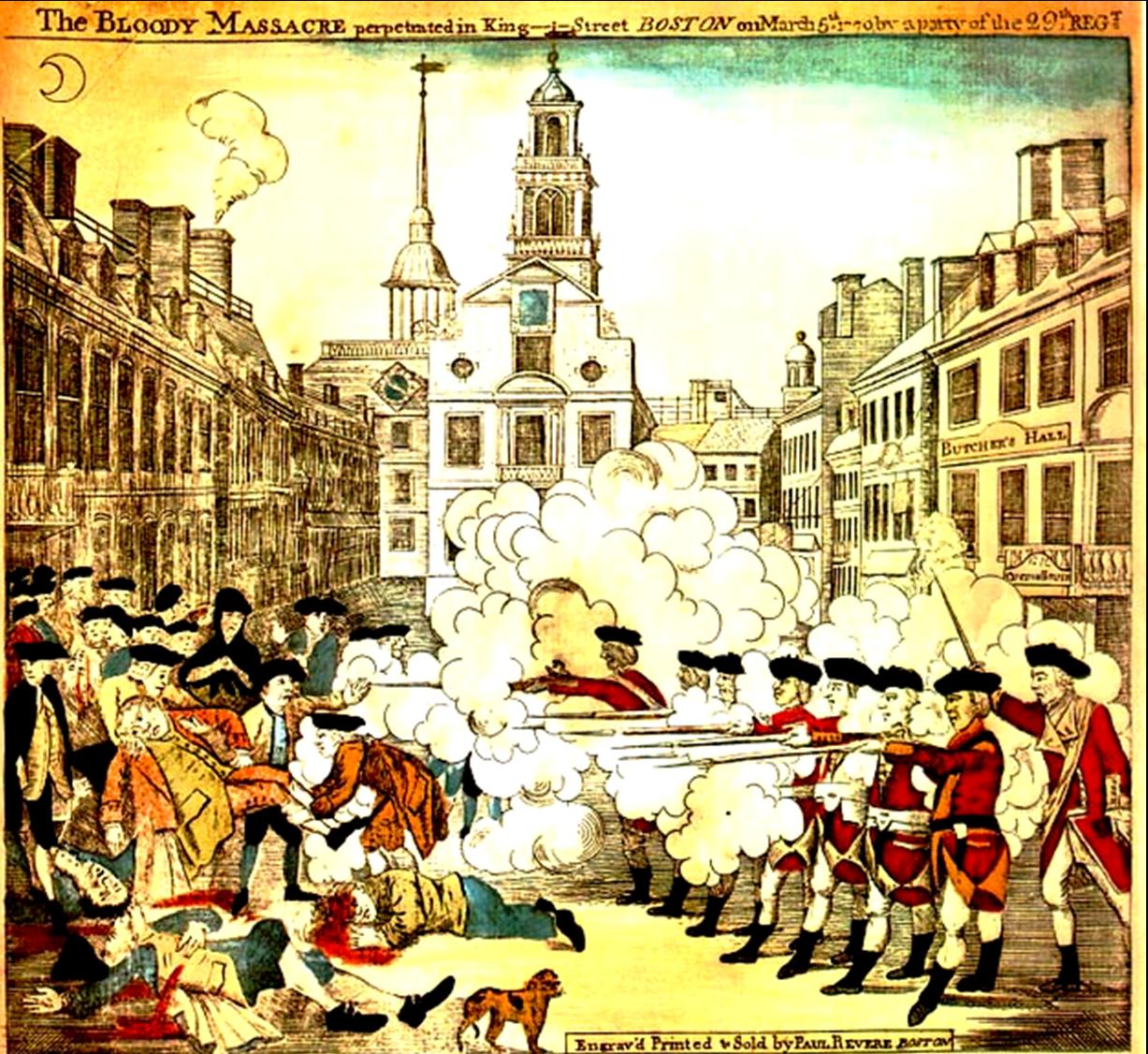
5. The Boston "Massacre" -British troops were sent as a sign of "defiant occupation" into Boston. Under Samuel Adams's lead, a group of colonists began to harrass the "terrified" soldiers until a street fight broke out and several colonists were "massacred". Was this indeed a massacre? Why or why not?
     Sam Adams was a brilliant propagandist (is that a word?). What other word could be more graphic than "massacre"? He published several pamphlets and papers inciting the British in this horrid act. The truth is that the British soldiers, mere boys themselves, felt threatened as they were being harrassed by the colonists. A fight did indeed break out and 5 colonists were indeed shot, but it was mostly a tragic ending to heightened emotions on both sides. Adams used this as "fuel to the fire" fomenting the rage and inevitable rebellion. It worked. John Adams defended the soldiers and got them off this charge, for which he was harrassed by many of the colonists; including his own cousin, Sam.

6. How was the Boston "Massacre" a catalyst? It was really what began the American Revolution.

7. Besides the many pamphlets and newspapers fomenting rebellion, what groups emerged further uniting the colonies toward revolution? The Sons of Liberty, http://en.wikipedia.org/wiki/Sons_of_Liberty Sons of Neptune, Philadelphia Patriotic Society, etc. All political groups supporting revolution against the tyranny of England.

  8. How was Paul Revere's social status important to his future famous "ride"? Everyone knew him. He was a member of many of these political groups. He was instrumental in setting up communication lines at a moment's notice among the colonists.

 9. The Boston Tea Party had tremendous significance to the American Revolution. Specifically what about that incident has carried over to today's "Tea Party"? Tea was crucial to early American life. The water was often tainted and undrinkable being full of disease or polution. So they drank tea almost exclusively. Because it was heavily taxed, and was shipped through England from the West Indies, the colonists wanted to make a real statment about taxation without representation. What better way than to dump hundreds of chests of tea overboard while the "local authorities looked on and condoned." Today's Tea Party was born out of frustration with a government that seems to care only about pushing an agenda through and not listening to the people. January of 2011, most Americans will see skyrocketing taxes on almost every aspect of their lives. 61% - 78% of the population disagrees with these policies. Taxation without representaion? Sure we have elected officials (and the colonists did not!) that are supposed to vote the way their constituents wish. We all know how that has turned out!

  10. What philosophical roles did John Locke, Thomas Hobbs, and Baron Charles de Montesquieu play in the revolution? Locke: limited government, "life, liberty and the pursuit of happiness"; Locke and Hobbs: government was created by man to "protect" him and those inalienable rights. Montesquieu: checks and balance of powers in government.

11. What role did the signers' Christian ideology play in signing the Declaration of Independence? Half the signers had seminary training and all had a devout belief in God and man's dependency on Him. Every household studied and was taught to read from the bible. God was the center of their lives and so played a critical role in this holy document.

12. How did the "Minutemen" differ from the British military? Why were they called "Minutemen"? This was a bunch of farmers, planters, merchants and dads. The colonists specifically did not want a standing army like the British had. They were not well-trained, uniformed, paid or schooled as the British army. But they knew that they could be called on on a "minute's" notice to fight and defend against the British empire.

13. What was significant about Lexington and Concord? Lexington was the location of the first battle of the Revolution. The British got word that the colonists were stocking and storing munitions in a shed in Concord. They devised a plan to seize the arms and capture the rebels Sam Adams, Paul Revere and John Hancock. But the colonists intercepted the message and the "minutemen" went into action. They signaled the British route with lanterns from the Old North Church which sparked Paul Revere's famous ride. "To arms! To arms!" warning the colonists of the approaching Redcoats. Incidently, William Dawes assisted in this courageous endeavor, but got the varitible and historical shaft from Longfellow in the famous poem Paul Revere's Ride. I'm sure if  Dawes' last name had rhymed with "Church" or "horse" or "nasty redcoat", he would certainly have been mentioned. http://www.legallanguage.com/resources/poems/midnightride/

  14. How did Paul Revere get word out that "the British were coming"? Who else rode with him? What was significant about the North Church? (See above!) The Minutemen came through and their lines of communication worked perfectly using the light of the lanterns on the Old North Church, spreading the word quickly through Paul Revere and the Sons of Liberty. Poor little William Dawes rode with him.

15. Who fired "the shot heard 'round the world..."? Some radical gun totin' red-necked, backwoods NRA supportin', bible thumpin' crazy lunatic....or....wait... no one still knows which side it was. He did it! No, he did it! Uh uh... you did it.....!

16. Why was George Washington called "The Indispensible Man"? What a remarkable human being! George Washington was well-respected among all men; whether a diplomat or commoner or one of his troops. But he respected them also. He practiced what he preached, and he preached loyalty to God and country. He defined the difference between his men and authority. If someone left his post, he received one to three hundred lashes.  He did not tolerate disobedience. Anyone who went AWOL was hanged for treason. He had an uncanny ability through strategy to win the war though he lost several battles. He had impeccable character and had a commanding air critical to being the commander of the American army at this time.

 17. What were the seven obstacles listed, that the British faced even though they were vastly more well-equipped than the colonists? Though they certainly should have won this war, they were 1) fighting in hostile territory, 2) not able to utilize their vast navy, 3) unable to distinguish a strategic port, 4) unable to effectively fight a frontier rebellion, 5) unable to keep the trust and support of the Indians, 6) unable to communicate well between commanders in the field and the crown in England, 7) not supported by the French when the French entered the war. The French were still stinging from the results of the Seven Year's War and wanted revenge.

                    18.  General George Washington, The Indispensible Man, had many See full size imagecrushing defeats. How can we say that his army's retreat across the Delaware River was a success or victory? Though it was indeed a retreat, it was a remarkable victory and act of faith... or miracle that he was able to get all his men and equipment across the river before the British attacked and literally massacred them all the following day. They were saved by a terrible unrelenting storm during the night and a miraculous soupy fog that hid them the following morning until the last man was across the Delaware and on shore. Washington himself, did not set foot on shore until his last man was safe.

  19. According to the signers, what role did God and government play in individual rights? God was all-powerful and allotted those rights. Government was merely a tool in protecting those rights from foreign and domestic threats.
  20. What human frailty caused Benedict Arnold to become the world's definition of "treason"? He was prideful and selfish because he was not given the accolades or recognition that he thought he deserved. He died penniless and only recognized in a most derogatory sense.

  21. Treaty of Paris ended the Revelutionary War. What did it stipulate? Land and territory was delegated and lines deliniated to the colonists, France, Spain, etc. Slave rights were also, sadly, included for those who had losses.
See full size image
See full size image
See full size image

Thursday, September 16, 2010

Teacher's Pet.... Already?

   There are some serious intelligent people in these history classes! Wow! We are learning a ton. So great! Tonight Linda S. gave an overview of the origins of slavery which was fascinating. I think she is secretly related to David Barton... she has read a ton and remembers a ton! Linda A. gave a short book review on Light and Glory by Peter Marshall, about Columbus, George Washington and how they were divinely inspired by God. Awesome. My library is getting fatter!
    Not to be outdone was Son Hee who made me this fabulous patriotic bag - complete with little brass elephants!  Isn't she cute?? (Son Hee - not the elephants...) She does these for charity and is a wonderful person. I really was speechless. Wow -thanks Son Hee. You really didn't have to do that... but you now get 1,000 extra credit points. We are going to have class pictures in a couple of weeks, so this will give you guys a chance to go buy a cute new outfit... and something to butter up the teacher....
    Class notes on chapter two follow... I have to go put stuff in my new bag.

Wednesday, September 15, 2010

Colonial Adolesence

    Last night I discovered a gold mine! Larry Schweikart's website! There is an entire curriculum for all grade levels complete with maps, quizzes, timelines based on his book! So check out http://www.patriotshistoryusa.com/ . It is awesome. Duh... you didn't already know that, Miss History teacher? I told my class today that they don't need me anymore... after only one week! Not really... Shirley made awesome cinnamon rolls today, so they're stuck with me. It is a great resourse. The best thing to do is get your own book and follow this incredibly insightful blog and use his website. Think how brilliant you'll be in no time! Or is that more brillianter? (Don't tell Mrs. Clayton I said that!)
Anyway... get rid of that cell phone that you're trying to hide from me and let's get to work on chapter two.
    The early colonists at this point, were kind of like little teenage punks. They didn't really know who they were, what they were about, or what they wanted. They just tried to look tough. Why can't I take the car? I've had my license for 4 days! Why am I the only one who has a curfew in the ENTIRE high school? Why don't you trust me? Ahhhh, youth....
    This is kind of how the colonists felt about the authoritarian English government. They weren't really "Americans" yet: they thought of themselves as Virginians, Georgians, South Carolinans, etc. Yet when they needed government intervention, they still turned to the crown. When England, Wales and Scotland formed the United Kingdom between 1707 and 1763, they tended to treat the colonists as subjects, not citizens. The colonial kids were starting to whine, and the king was getting a little irritated with these twits thousands of miles away.

   So - early Amerian life: American universities began to pop up. The biggies like Harvard, Princeton, Rutgers, William and Mary, etc. Though their curriculum was mainly religion-based, there were marked differences from the mother country.  Many graduates chose a different field than religion while attending school. Many schools broke tradition and became more secular and introduced French and German while dumping the Latin and Greek languages. (horrors!) The big change was, however, that the leadership was not clergy. John Adams, who had graduated from Harvard, appointed a board of trustees. This kept a state religion from dominating higher education.
   These people were in survival mode. They had to build their shelter, kill or plant their food, weave their own cloth. Life was extremely simple. Their literature consisted of the bible, short "how to" books on farming and planting. Reading was pragmatic not fluffy or frivolous. They certainly weren't purchasing any of the books hot of the press in England. They had little time for philosophy, the arts, Greek plays. Instead they made gospel music, folk ballads and read poetry by Anne Bradstreet about divine intervention and self-improvment. Very useful, down to earth stuff.
    Very popular were the writings of Benjamin Franklin. The guy was a machine! He could do anything! He invented bifocals, the Franklin Stove, discovered electricity and still had time to write! He produced Poor Richard's Almanac which gave crop advice, weather forecasts, folksy advice, witticisms, etc. He also wrote the 13 Virtues http://www.flamebright.com/PTPages/Benjamin.asp which he tried to live by everyday of his life. I'm sure all of today's politicians live by these same virtues... or something...
     Professions: How did someone become a doctor or lawyer? Some had an apprenticeship, but some just decided that's what they wanted to be. In many small towns, a person may have had two or three professions. It was on the job training. So you just got a sign and hung it out on the door like... "Doctor Kavorkian... Surgery, Croissants, and Fill Dirt." Hmmm.... I  guess that was before they required 13 years of school. But guess what? Hey, wait a minute... I think we're going back to that soon! Won't that be great?
   The First Great Awakening: This is cool. Because of those free market principles and man's yearning to be self-reliant and make his own decisions, (don't remember how that works without government?) preachers who were disillusioned with the establishment religions decided they wanted to start a church or churches based on what they believed. Itinerant preachers traveled to camp meetings and preached away. Some felt that they were "called" to this position and others engaged in a "fast track" sort of theological training. (maybe hung out a really cool sign?) The colonists loved it! They latched on to this idea because they could! They didn't have the thumb of the Church of England telling them how to worship. Two great evangelists came on the scene during this time. Jonathan Edwards and George Whitefield. They were the "hellfire and damnation" kind of preachers. Whitefield was a courageous and wonderful preacher who did much to promote freedom of religion. He was a great actor too, apparently, because he would act out bible stories and play all the different characters. His depiction of Satan would frighten the little colonists right out of their skins.. and sins! Teary eyed and shaking, they would crawl to the front and promise to change their wicked lives.
    Jonathan Edwards used the same soothing tactics. He described their relationship to God from his work Sinners in the Hands of an Angry God as "...God holds you over the pit of hell, much as one holds a spider, or some loathsome insect." And then dad and mom would gather up the kiddies and skip home to eat ice cream. The preachers of the First Great Awakening were kind of like rock stars because by 1740, their popularity began to wane. Edwards even became a recluse, but one positive aspect was that a central controlling religion continued to be decentralized. Many new religions emerged like the Methodists, Presbyterians, and Baptists. The stage was now set for the Second Great Awakening which we will talk about in a few weeks.

  Slavery's American Origins and Evolution: Colonists did not come over here with the intention of having slaves. This certainly didn't happen over night. Why did the Africans succomb to slavery whereas the Indians and indentured servants wouldn't have anything to do with it? The Africans were certainly more vulnerable because the Gold Coast had already been exploited in a thriving slave trade led by the Muslims. 
      Another factor promoting slavery was indentured servants who had their passage to America paid for and in return, worked for 7 years to pay it off. With crops so lush and productive, and plantations popping up everywhere, the labor force was sorely lacking. What to do? Well... owners either tacked on a couple of years to the indentured servant, but more often, they bought slaves from the Dutch and other traders who dealt in human trafficking. It was a horrible situation; one where these deeply religious colonists somehow got to the place in their heads that this was ok or at best, "a necessary evil". I'm not going to delve into the demoralization of slaves and the inhumane way they were chained and shackled on their journey because, frankly, it makes me sick. Schweikart and Allen describe this dark period in America's past tastefully and you can do a plethora of other research on your own. It was almost a horrid case of "everybody's doing it"  until it escalated into a nightmare. Even many of the forefathers that had slaves realized how awful it was and just hoped it would "go away". It didn't. Some were in such denile, they had to make themselves sound benevolent. They believed that many slaves were so incompetent that slaves owners were actually doing them a favor by enslaving them. Really??

   At this point, the big money making crops were indigo and tobacco. Cotton was plentiful but tedious to work with - separating the fibers from the seeds. Eli Whitney' Cotton Gin helped to expedite the work. The tedious work was cut in half. They could produce so much more so much faster that the demand for slave labor increased instead of decreased.

 Immigrants were brought by General James Oglethorpe who had some ideas that looked good on paper but... didn't work out too well. He had a bunch of deviants from prison immigrate to a settlement that would be a buffer against the Spanish in case of an attack. Duh... that should have been a red flag! Oglethorpe discovered that they wanted to limit his power. "Former convicts actively opposed his ban of rum (sobriety, they believed, would not expedite their rehabilitation. What did you expect?? They're convicts for crying out loud!) They also overturned his ban on slavery and imported nearly ten thousand slaves. Soon, Ogelthorpe surrendered, and Georgia became the last of the thirteen colonies.

Wars, wars, wars... many countries vying over the great land in America outside the thirteen colonies. King Williams' War, http://www.usahistory.info/colonial-wars/King-Williams-War.htmlQueen Anne's War, http://www.u-s-history.com/pages/h846.html The War of Jenkins's Ear, http://www.history1700s.com/articles/article1070.shtmlKing George's War http://www.usahistory.info/colonial-wars/King-Georges-War.html
   The end result was England darn near controlling the whole enchilada! Remember how just a few decades back, they were way behind Spain and everyone else? Not any more. King George III is on the throne now - literally - and he's a little ticked at the $137 million tab that the war costs. Remember the good old days when $137 million was a lot of money? He was also ticked that he had to pay interest of $5 million. Memories are great, huh? So - how to do it? He wanted to tax the Americans that caused the whole darn thing. BUT... the Americans had no say or representation in the matter. They basically said, "No way... taxation without representation is evil and we're not doing it." Well... Georgie didn't like these little twits getting in his face.
   Things are heatin' up guys... things are heatin' up....